S
Mining helmets primarily protect against solid impacts, yet detecting hazardous gases is vital in deep mines. Improved security is imperative due to the severity of underground disasters such as gas explosions and inadequate lighting. Blame for accidents often rests on supervisors, emphasizing the need for better communication among miners, supervisors, and control stations. The proposed system aims to bolster mining safety by integrating a network into helmets. This network senses the miner’s environment and transmits real-time data online via IoT. This enables the control station to monitor conditions and provide immediate assistance during emergencies. The system comprises an Arduino microcontroller, LCD, and buzzer for signaling coworkers during crises. Various sensors, including those for Gas, Humidity, Temperature, LDR, and IR, contribute to the system’s functionality, with the IR sensor acting as a helmet removal sensor.
- Arduino Microcontroller
- IR sensor

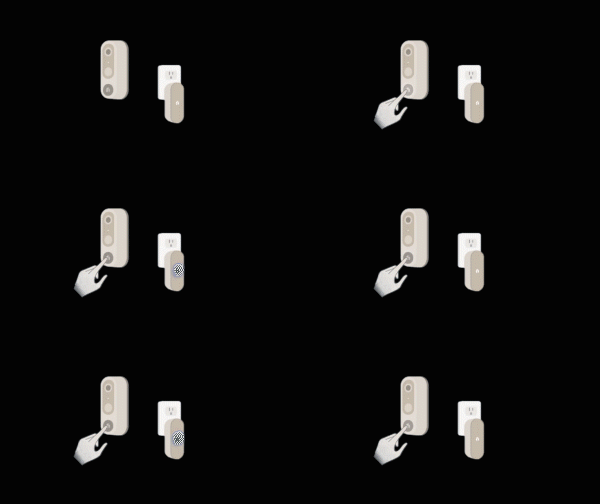
In the battle against COVID-19, social distancing is vital. While we’re encouraged to stay home, essential visits may be necessary. However, traditional doorbells can transmit the virus through touch. A solution is to convert them into contactless doorbells using IoT. An Arduino board and an Ultrasonic Sensor HC-SR04 are used to sense a person’s presence and activate a Servo motor to press the doorbell switch. This setup is cost-effective and helps prevent virus spread. The Arduino microcontroller plays a central role, enabling a buzzer sound as well. This contactless doorbell minimizes physical contact, enhancing safety during the pandemic.
- Arduino Automation
- IoT Doorbell
S
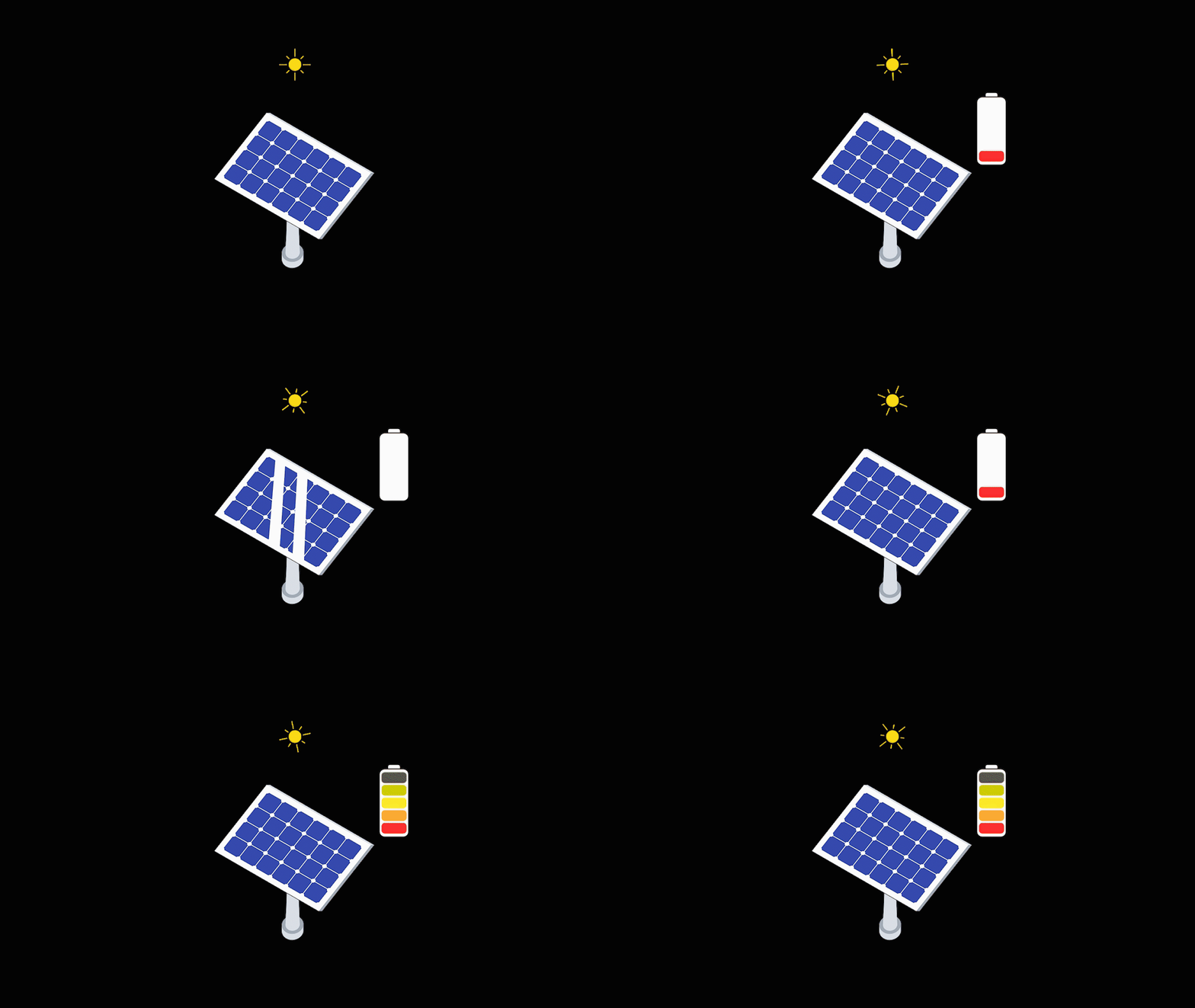
Solar panels are increasingly popular for converting solar energy into electricity. They can operate as stand-alone systems or connect to the grid. Earth receives 84 Terawatts of solar power daily, while we consume 12 Terawatts. To maximize solar-to-electrical energy conversion, panels need to be positioned perpendicularly to the sun. This project aims to design an automatic tracking system that locates the sun’s position and adjusts the solar panel accordingly. It utilizes photoresistors as sensors and comprises a light-sensing system, an Arduino microcontroller, gear motors, and the solar panel. The system is expected to boost energy output by up to 40% compared to static panels. The key component is the light-dependent resistor (LDR) connected to the Arduino, which continuously tracks the sun. Two servo motors reposition the solar panel in real-time to keep it facing the sun. This innovation offers an efficient and sustainable solution for meeting our increasing energy demands.
- Arduino Automation
- Light-Dependent Resistor (LDR)
H
Efficient communication between an autonomous robot and its operator is crucial, supported by extensive research highlighting the pivotal role of this technology. Nonetheless, developing these robots remains a formidable challenge. A fully autonomous robot should not only perform assigned tasks but also establish a connection with its operator. Our aim was to design a robot capable of tracking and approaching the target while maintaining visual contact. We achieved this by using a custom-made tag on the target for easy recognition. The main challenge was accurately identifying the target, requiring a distinctive tag for seamless recognition and execution. Our custom tag simplifies this process. Moreover, collision prevention is handled through sensors, while the microprocessor manages data processing and the controller oversees motor control.
- Autonomous Robotics
- Human-Robot Interaction

Aeroponic has several advantages over traditional agriculture, aimed to improve the efficiency and environmental impact of agriculture. This technique contains monitoring and automation for proper operation. Automatic monitoring aeroponic-irrigation systems are based on IoT and Arduino. Analog and Digital sensors for measuring the temperature, humidity, pressure, pH, water flow and level of a nutrient solution. Meanwhile, the control system was used to manage actuators. Sensor’s data are transmitted via the internet into servers in order to facilitate easier monitoring for users. The prototype of the system is successfully implemented and provides a sensor’s data.
- Aeroponics
- IoT Farming

Modern smart street lights are energy-efficient, utilizing light sensors to illuminate roads at night and automatically switch off in the morning. This automation aims to reduce power consumption when there’s no vehicle activity. Automation, driven by technology, simplifies tasks and reduces the need for human labor in various industries. It plays a crucial role in the global economy and daily life. Automatic street lights, employing IR sensors, save energy by lighting up a block of lights as a vehicle approaches, turning them off as it passes. This innovation helps conserve a significant amount of energy, keeping lights off when no vehicles are on the road
- IR Sensor Technology
- Smart Street Lighting